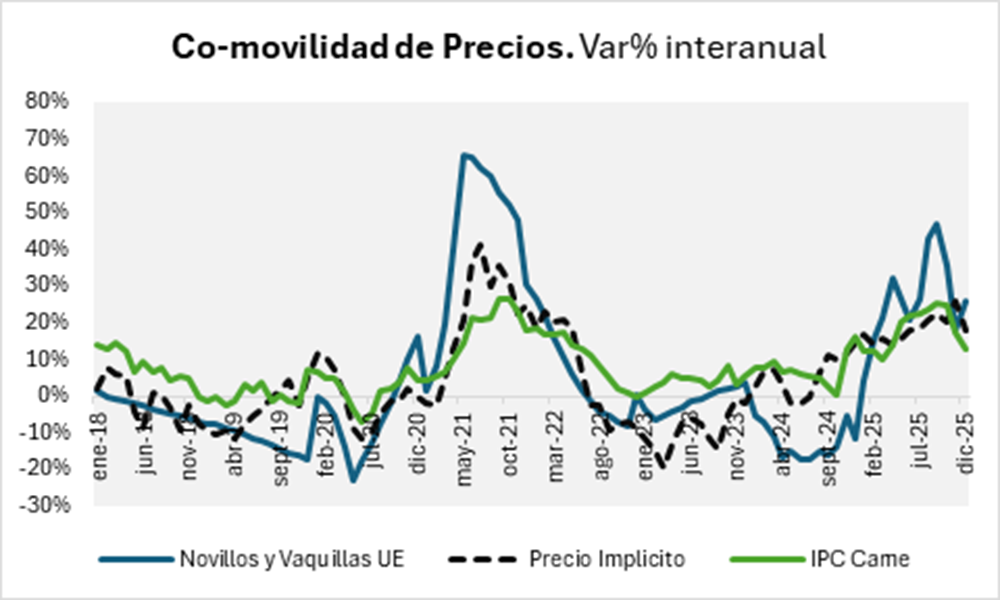
Analysis of year-on-year price variations reveals a close co-mobility between the implicit export price of beef and the carcass prices of different cattle breeds. This relationship is not only statistically significant but also consistently maintained over time, reflecting an effective transmission of international signals to the local market.
The data also show that this transmission is not merely proportional. During periods of significant increases in the implicit export price, carcass prices tend to register larger increases, especially during phases of strong international demand expansion. This behavior was clearly observable during the 2020–2021 upward cycle and the more recent 2024–2025 rebound, when year-on-year variations in carcass prices systematically outpaced those of the implicit export price.
This pattern reflects that, in the face of positive international price shocks, competition intensifies among meatpacking plants to secure the available cattle supply. In a context of strong export orientation and significant installed capacity, the pressure to capture volume is quickly—and in some cases amplified—transmitted to the prices paid to producers. Far from demonstrating buyer market power, this dynamic is consistent with an integrated market, where agents compete to take advantage of favorable external opportunities.
By way of illustration, during 2025, considered a period of booming international prices, the implicit export price increased by around 18%, while the hook-gate price of various cuts registered increases of approximately 26%. This difference reveals a high pass-through, even exceeding one at certain points in the cycle, a behavior incompatible with the hypothesis of deliberate price containment for producers.
From an economic perspective, this dynamic is consistent with the theory of price transmission in open markets and with the Law of One Price. In an economy that takes international prices, positive external shocks are not only transmitted to the domestic market, but can do so with greater intensity when there are relative constraints on primary supply, expectations of a continued upward price cycle, and active competition for key inputs. In this context, the farmgate price acts as an endogenous adjustment variable that quickly internalizes signals from the international market.
Empirical evidence also shows that price transmission is not limited to the primary link, but extends throughout the entire meat supply chain, reaching consumer beef prices in the domestic market. A high degree of intertemporal co-mobility is observed between the implicit export price, the farmgate price, and meat inflation, both during upward and downward phases of the international cycle.

In this regard, the correlation between the year-on-year change in the implicit export price and the year-on-year inflation of beef in the domestic market reaches values close to 0.84, while the correlation between the change in the carcass price and beef inflation is around 0.79. These indicators confirm that increases and decreases in international prices are significantly and persistently passed on to both the primary producer and the final consumer.
If there were a systematic exercise of market power by the industrial sector, one might expect a disruption in this transmission mechanism, manifested in an artificial suppression of prices during periods of international price increases. However, the evidence shows the opposite: a broad, bidirectional, and consistent transmission, characteristic of open markets integrated into global dynamics.
It is also important to note that the evolution of beef prices for consumers is influenced by internal factors beyond the industrial sector, such as weather conditions, cattle availability, logistics costs, the retail marketing structure, and domestic demand. These variables complement the explanation of price formation and reinforce the idea that the market is not unilaterally controlled by a single segment of the supply chain.
In this context, the co-mobility observed between international prices, farmgate prices, and consumer prices does not constitute evidence of collusion, but rather a natural manifestation of the degree of vertical and commercial integration within the Paraguayan beef supply chain. Interpreting this dynamic as a failure of competition would imply a lack of understanding of the basic functioning of price transmission mechanisms in open, highly export-oriented economies.